
How to Choose a Drone Battery Manufacturer for UAV Applications
Choosing the right drone battery manufacturer is an important decision for UAV manufacturers, engineering teams, and procurement professionals. A battery pack must do more than provide sufficient capacity. It needs to deliver the required power, meet weight and dimensional constraints, support the intended flight profile, and operate reliably under demanding conditions.
Whether you are developing agricultural spraying drones, industrial inspection UAVs, mapping platforms, cargo drones, or FPV aircraft, selecting a suitable battery supplier requires a careful evaluation of battery technology, electrical specifications, customization capabilities, and manufacturing quality.
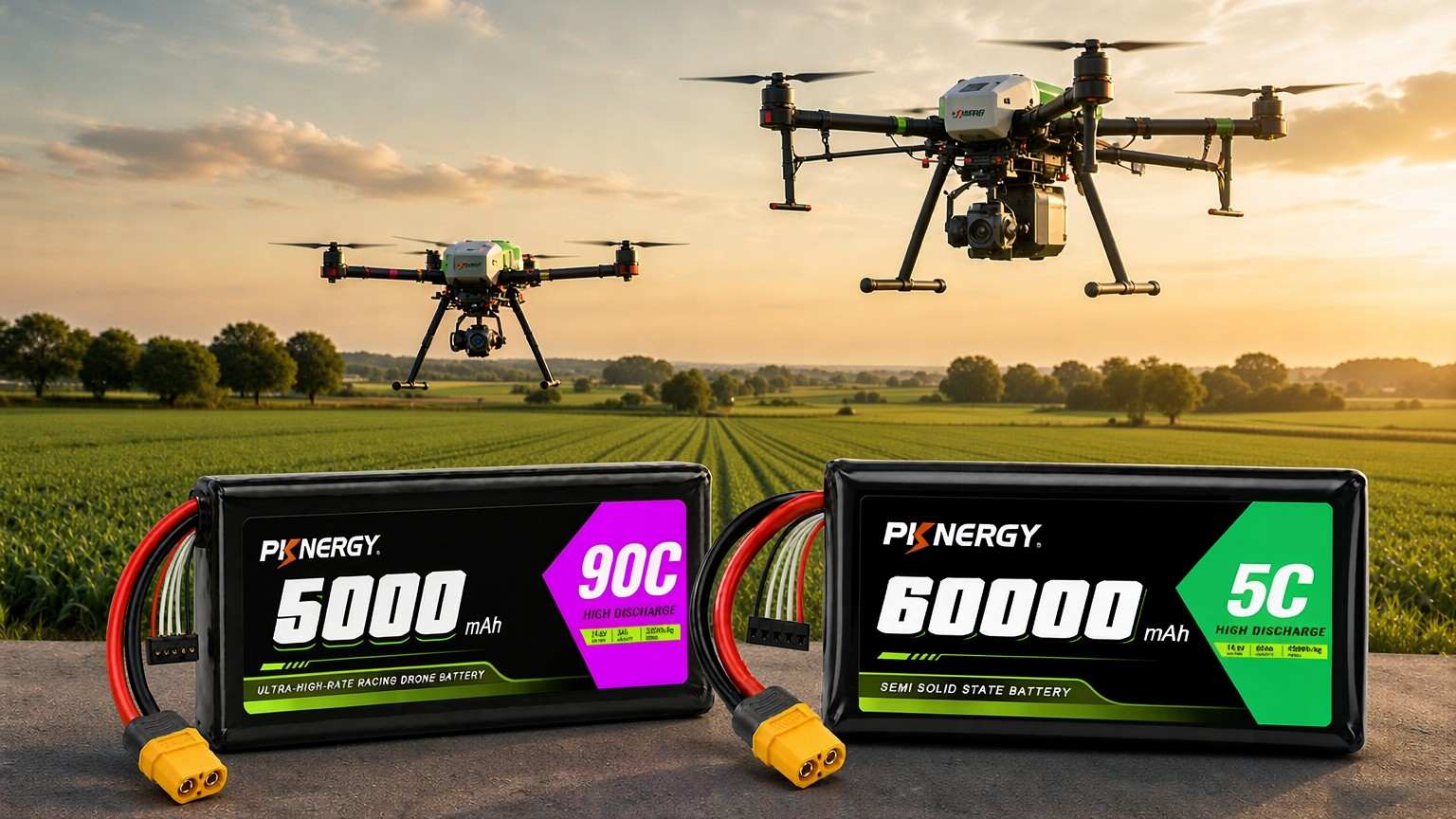
This guide explains the key technical and commercial factors to consider when choosing a drone battery manufacturer. It also introduces different UAV battery configurations and explains how to evaluate battery specifications for specific drone applications.
In This Guide
- Understand Your UAV Power Requirements
- Evaluate Energy Density and Battery Weight
- Check Discharge Rate and Power Performance
- Compare Different Drone Battery Technologies
- Match Battery Voltage and Capacity
- Evaluate Battery Customization Capabilities
- Assess Manufacturing Quality and Testing
- Choose Batteries for Different UAV Applications
- Why Consider PKNERGY for UAV Battery Solutions?
- Frequently Asked Questions
1. Understand Your UAV Power Requirements
Before contacting a drone battery manufacturer, define the electrical and mechanical requirements of your UAV platform. Different drones have different power demands depending on their size, propulsion system, payload, flight duration, and operating environment.
A battery designed for a lightweight mapping drone may not be suitable for an agricultural spraying UAV. Similarly, a high-discharge battery for an FPV racing drone may have different priorities from a high-capacity battery designed for industrial operations.
Key Specifications to Define
| Specification | What to Consider | Why It Matters |
|---|---|---|
| Nominal Voltage | Required battery voltage and cell configuration | Must match the UAV power system |
| Capacity | Required Ah or mAh | Influences available energy and potential flight duration |
| Continuous Discharge | Maximum sustained current demand | Supports continuous propulsion power requirements |
| Peak Discharge | Short-duration current demand | Handles temporary high-power loads |
| Battery Weight | Maximum allowable pack weight | Affects payload and flight performance |
| Dimensions | Available installation space | Ensures mechanical compatibility |
| Operating Temperature | Expected environmental conditions | Affects battery performance and service life |
Providing these details helps a manufacturer evaluate whether an existing battery model is suitable or whether a customized battery pack is required.
2. Evaluate Energy Density and Battery Weight
Energy density is one of the most important considerations when selecting a battery for UAV applications. It describes how much energy a battery can store relative to its weight or volume.
For drone manufacturers, gravimetric energy density, measured in Wh/kg, is particularly important because the battery is part of the aircraft’s total takeoff weight. A higher energy density can help reduce battery weight for a given energy requirement or provide more stored energy within a similar weight allowance.
How Energy Density Influences UAV Performance
- Flight duration: More stored energy within a given battery weight may support longer flight missions.
- Payload capacity: Reducing battery weight may leave more weight allowance for cameras, spraying equipment, sensors, or cargo.
- Aircraft design: Battery weight and dimensions influence frame design and weight distribution.
- Operational efficiency: Suitable battery energy characteristics can help UAV designers optimize mission performance.
PKNERGY offers semi-solid-state UAV battery solutions with an energy density of up to 450Wh/kg in the specified product range. These batteries are designed for UAV applications where high energy density and weight considerations are important.
PKNERGY Semi-Solid-State UAV Battery Specifications
| Energy Density | Up to 450Wh/kg |
| Capacity Range | 36–60Ah |
| Voltage Range | 14.8–51.8V |
| Continuous Discharge Rate | 2C |
| Short-Time Discharge Rate | 2.5–5C (up to 15 seconds) |
| Product Weight Range | Approximately 1.15–5kg |
Specifications represent the semi-solid-state product range. Actual values depend on the selected model and configuration. Please confirm the applicable datasheet before selection.
However, energy density should never be evaluated in isolation. Discharge performance, thermal behavior, battery weight, operating conditions, and cycle life must also be considered when selecting a battery for a particular UAV.
3. Check Discharge Rate and Power Performance
Drone propulsion systems can require substantial current, especially during takeoff, acceleration, climbing, maneuvering, and heavy-payload operations. This makes discharge capability an essential factor when choosing a UAV battery.
The C-rate describes how quickly a battery is charged or discharged relative to its rated capacity. A battery rated at 10Ah with a 2C continuous discharge capability has a nominal continuous current rating of 20A.
Discharge Current Formula
Current (A) = Capacity (Ah) × C-rate
Example: 10Ah × 2C = 20A continuous discharge current.
Continuous vs. Peak Discharge Rate
Continuous discharge refers to the current a battery can deliver over its specified continuous operating conditions. Peak discharge refers to a higher current that can be delivered for a limited period.
These ratings are not interchangeable. UAV manufacturers should check both the current demand of the propulsion system and the duration of any high-power operating conditions.
| Battery Performance | Typical Consideration | UAV Application |
|---|---|---|
| Continuous Discharge | Sustained propulsion load | Industrial and agricultural UAVs |
| High-Rate Discharge | High current demand | FPV and high-performance drones |
| Short-Time Peak Discharge | Temporary power surges | Takeoff and acceleration |
For example, PKNERGY’s semi-solid-state UAV battery range offers a 2C continuous discharge rate and 2.5–5C short-time discharge capability for up to 15 seconds, depending on the applicable product specifications.
For high-performance applications, PKNERGY also offers high-rate and racing UAV battery solutions. The racing battery range includes selected configurations with discharge ratings of up to 90C.
Explore High-Rate UAV Batteries →
Explore Racing UAV Batteries →
4. Compare Different Drone Battery Technologies
Not all drone batteries use the same cell structure or battery technology. Semi-solid-state, cylindrical, and pouch battery configurations offer different characteristics in terms of energy density, packaging flexibility, weight, and power performance.
A reliable UAV battery manufacturer should be able to explain the differences between available battery solutions and help match the battery configuration to the aircraft’s actual requirements.
Semi-Solid-State UAV Batteries
Semi-solid-state battery technology is an option for UAV platforms that prioritize high energy density and weight efficiency. PKNERGY’s semi-solid-state UAV battery range offers energy density of up to 450Wh/kg, with selected capacities from 36Ah to 60Ah.
These batteries can be considered for agricultural spraying, heavy-lift, cargo, and industrial UAV platforms where energy capacity and battery weight are important design considerations.
View Semi-Solid-State UAV Battery Products →
Cylindrical UAV Batteries
Cylindrical lithium-ion cells are widely used in battery pack engineering. Their standardized cell formats provide manufacturers with different options for pack configuration, electrical design, and mechanical integration.
For UAV applications, cylindrical battery packs can be designed around specific voltage, capacity, current, and installation requirements. The final performance depends on cell selection, pack configuration, electrical connections, and thermal design.
View Cylindrical UAV Battery Products →
Pouch UAV Batteries
Pouch cells use a flexible laminated packaging structure and are often selected for applications where low weight and packaging flexibility are important. They provide battery designers with opportunities to develop compact configurations for different UAV platforms.
PKNERGY’s pouch UAV battery range includes selected products with energy density of up to 335Wh/kg. The appropriate model should be selected according to the aircraft’s required voltage, capacity, discharge rate, and mechanical dimensions.
High-Voltage Pouch UAV Batteries
High-voltage pouch battery solutions are designed for UAV systems that require higher nominal pack voltage. PKNERGY’s high-voltage pouch UAV range covers 15.2–53.9V and capacities from 8,000mAh to 16,000mAh.
These configurations can be considered for UAV platforms with specific voltage requirements, including industrial and specialized flight applications.
View High-Voltage Pouch UAV Batteries →
High-Rate and Racing UAV Batteries
High-rate battery configurations are designed for applications that require substantial current output relative to battery capacity. Racing drones and other performance-oriented platforms may prioritize power delivery, weight, and rapid throttle response.
PKNERGY’s racing UAV battery range includes selected 14.8V and 22.2V configurations with capacities of 5,000–8,000mAh and discharge ratings of up to 90C. Its high-rate pouch range also covers selected 14.8V and 22.2V configurations with capacities from 1,500mAh to 5,000mAh.
Comparison of PKNERGY UAV Battery Solutions
| Battery Type | Energy Density | Voltage Range | Capacity Range | Main Characteristics |
|---|---|---|---|---|
| Semi-Solid-State | Up to 450Wh/kg | 14.8–51.8V | 36–60Ah | High energy density |
| Pouch | Up to 335Wh/kg | Model dependent | Model dependent | Lightweight packaging |
| High-Voltage Pouch | Model dependent | 15.2–53.9V | 8,000–16,000mAh | Higher-voltage configurations |
| High-Rate Pouch | Model dependent | 14.8/22.2V | 1,500–5,000mAh | High-current applications |
| Racing UAV | Model dependent | 14.8/22.2V | 5,000–8,000mAh | Up to 90C discharge rating |
Note: Specifications shown above are based on the available PKNERGY product range information. They are not universal specifications for every model. Please refer to individual product datasheets for exact electrical and mechanical parameters.
5. Match Battery Voltage and Capacity
Battery voltage and capacity must be compatible with the UAV’s electrical architecture. Selecting an unsuitable voltage or capacity can affect propulsion performance, power management, and flight system compatibility.
Battery Voltage and Series Configuration
The number of cells connected in series determines the nominal voltage of a battery pack. For example, a 4S lithium-ion polymer battery with a nominal cell voltage of 3.7V has a nominal pack voltage of 14.8V.
UAV engineers should confirm the supported voltage range of the electronic speed controllers, motors, power distribution system, and other electronic components before selecting a battery configuration.
Battery Capacity and Parallel Configuration
Battery capacity, commonly expressed in Ah or mAh, indicates the amount of electrical charge a battery can store. In general, higher capacity can provide more stored energy when voltage remains comparable. However, increasing capacity may also increase battery weight and dimensions.
For a UAV manufacturer, the goal is not simply to select the largest possible battery. The battery should provide sufficient energy while staying within the aircraft’s weight, space, and power limitations.
A battery manufacturer should help evaluate the relationship between voltage, capacity, cell configuration, discharge requirements, and total pack weight.
6. Evaluate Battery Customization Capabilities
Standard battery products may not meet every UAV design requirement. Different aircraft platforms can have different battery compartments, connectors, mounting structures, communication requirements, and electrical specifications.
This is why customization capabilities are important when choosing a long-term drone battery manufacturing partner.
Important Customization Factors
- Voltage and capacity: Battery configuration based on the required electrical specifications.
- Dimensions and weight: Pack structure designed around the available installation space and weight allowance.
- Connector selection: Compatible power connectors and cable arrangements.
- BMS configuration: Battery protection and monitoring requirements where applicable.
- Communication interface: Communication requirements between the battery and UAV system.
- Mechanical structure: Housing, mounting, and connection design.
- Operating conditions: Temperature and environmental requirements for the intended application.
When discussing a customized UAV battery, it is important to provide a clear technical specification rather than only describing the desired flight time. A battery supplier can then evaluate the electrical configuration and determine whether an existing product or a customized design is more suitable.
7. Assess Manufacturing Quality and Testing
Battery performance is not determined by cell specifications alone. Pack assembly, electrical connections, protection systems, component consistency, and production controls all influence the final battery’s performance and reliability.
When evaluating a drone battery manufacturer, procurement teams should ask how the company manages quality throughout the manufacturing process.
Questions to Ask a UAV Battery Manufacturer
| Evaluation Area | Questions to Ask |
|---|---|
| Cell Selection | How are battery cells selected and matched? |
| Pack Assembly | What assembly and connection processes are used? |
| Electrical Testing | Are voltage, capacity, resistance, and discharge performance checked? |
| Protection System | What protection functions and monitoring options are available? |
| Product Consistency | How is consistency maintained between production batches? |
| Documentation | Can the supplier provide product datasheets and applicable test documents? |
| Transportation | Can the supplier provide applicable lithium battery transport documentation? |
For commercial UAV projects, sample evaluation is also important. Before mass production, engineering teams should verify battery compatibility with the aircraft and evaluate performance under representative operating conditions.
Depending on the product and destination market, buyers should also request applicable documents such as UN38.3 test summaries, safety documentation, and transportation-related information.
8. Choose the Right Battery for Different UAV Applications
The ideal battery configuration depends on the UAV’s mission profile. Different applications prioritize different combinations of energy density, discharge capability, capacity, weight, and operating characteristics.
Agricultural Spraying Drones
Agricultural UAVs often operate with spraying equipment and liquid payloads. Battery selection should consider takeoff weight, continuous propulsion demand, flight duration, and repeated operating cycles. High energy density and suitable discharge performance are important factors for these platforms.
Industrial Inspection and Mapping Drones
Inspection and mapping UAVs may carry cameras, LiDAR systems, thermal imaging equipment, and other sensors. Battery weight, energy capacity, and electrical compatibility should be evaluated according to the payload and required mission duration.
Cargo and Heavy-Lift Drones
Cargo and heavy-lift UAVs have demanding propulsion requirements because they must carry substantial payloads. Battery selection should focus on energy capacity, sustained current delivery, pack weight, and the aircraft’s maximum electrical load.
FPV and Racing Drones
FPV and racing drones generally prioritize high power output, rapid throttle response, and low battery weight. High-rate lithium battery configurations are commonly considered for these applications. The required discharge rate must be evaluated against the actual current demand of the propulsion system.
Cinema and Professional Filming Drones
Professional filming UAVs may need to carry cameras, gimbals, and additional recording equipment. Battery selection should balance energy capacity, weight, voltage compatibility, and stable power delivery throughout the planned flight.
A suitable manufacturer should understand these different requirements and help customers select battery configurations according to the intended UAV application.
9. Why Consider PKNERGY for UAV Battery Solutions?
PKNERGY provides lithium battery solutions for different UAV and drone applications, covering multiple battery structures and performance requirements. Its product portfolio includes semi-solid-state, cylindrical, pouch, high-voltage, high-rate, and racing UAV battery configurations.
Rather than relying on a single battery design, PKNERGY offers different product options for UAV projects with varying requirements for energy density, voltage, capacity, discharge performance, and battery structure.
Multiple UAV Battery Configurations
From high-energy-density semi-solid-state batteries to high-rate racing battery solutions, PKNERGY’s product range supports different UAV power requirements. Customers can evaluate existing product models according to their aircraft specifications and application needs.
Explore PKNERGY UAV Battery Products
- Semi-Solid-State UAV Batteries – High energy density solutions for demanding flight applications.
- Cylindrical UAV Batteries – Cylindrical cell-based battery configurations.
- High-Voltage Pouch UAV Batteries – High-voltage battery configurations for specialized UAV systems.
- High-Rate UAV Batteries – Battery solutions for applications requiring higher current output.
- Racing UAV Batteries – High-discharge battery solutions for racing and FPV applications.
Technical Selection for Different UAV Projects
Every UAV project has its own electrical and mechanical requirements. Battery selection should be based on the actual aircraft design rather than choosing a model solely by its advertised capacity or energy density.
When evaluating a battery solution, PKNERGY customers can provide their voltage, capacity, discharge current, weight, dimensions, connector, and application requirements for product matching and technical discussion.
For manufacturers developing new UAV platforms, early communication with a battery supplier can also help identify battery configuration requirements before finalizing the aircraft’s power system.
Looking for a Drone Battery Manufacturer?
Whether you need a high-energy-density UAV battery, a high-discharge racing battery, or a customized lithium battery pack for an industrial drone, PKNERGY can help you explore suitable battery configurations for your project.
10. Frequently Asked Questions
1. What should I look for in a drone battery manufacturer?
Look for a manufacturer that understands UAV power requirements and can provide suitable battery configurations, technical specifications, customization options, product documentation, and quality evaluation support. Relevant experience with your intended drone application is also important.
2. What type of battery is best for industrial drones?
The best battery depends on the aircraft’s payload, flight duration, propulsion system, and electrical requirements. High-energy-density batteries may be suitable for applications that prioritize weight efficiency, while high-rate configurations may be more appropriate for drones with demanding power requirements.
3. What is a good energy density for a drone battery?
There is no single energy density that is suitable for every UAV. The required value depends on the aircraft’s weight allowance, flight mission, payload, and power demand. Higher energy density can improve the energy-to-weight ratio, but discharge capability and operating conditions must also be evaluated.
4. What is the difference between continuous and peak discharge rates?
Continuous discharge is the current a battery can deliver under its specified sustained operating conditions. Peak discharge is a higher current available for a limited duration. Both ratings should be checked when matching a battery to a drone’s propulsion system.
5. Can a drone battery be customized?
Yes. Depending on the manufacturer’s capabilities, a UAV battery pack may be customized in terms of voltage, capacity, dimensions, weight, connectors, wiring, battery management system, and communication requirements. The final design must be evaluated against the aircraft’s electrical and mechanical specifications.
6. How do I calculate the required drone battery capacity?
Battery capacity should be estimated from the UAV’s average current consumption and the intended operating duration. A simplified calculation is: Required Capacity (Ah) = Average Current (A) × Operating Time (h). The actual design should also account for usable battery capacity, discharge limits, safety margins, and operating conditions.
7. What information should I provide when requesting a custom UAV battery?
Provide the required voltage, capacity, continuous and peak discharge current, maximum battery weight, available dimensions, connector type, application, operating temperature, and any BMS or communication requirements. Technical drawings or the existing battery specification can also help the manufacturer evaluate the project.
Conclusion
Choosing a reliable drone battery manufacturer requires more than comparing battery capacity and price. UAV manufacturers should evaluate energy density, discharge performance, voltage compatibility, battery weight, cell structure, customization capabilities, and manufacturing quality.
The right battery solution should match the aircraft’s power system and mission requirements while providing a practical balance between energy capacity, weight, and performance.
With multiple UAV battery configurations, including semi-solid-state, cylindrical, pouch, high-voltage, and high-rate solutions, PKNERGY provides different options for customers developing agricultural, industrial, inspection, mapping, cargo, and racing drone platforms.
Contact PKNERGY to discuss your UAV battery requirements and explore a suitable lithium battery solution for your drone project.